Three words show up on almost every sustainable mailer listing: recyclable, compostable, and biodegradable. Buyers treat them as synonyms for “good for the planet.” They are not synonyms. Each describes a different end-of-life pathway, each is governed by different rules, and putting the wrong one on your kraft mailer can turn a well-meant claim into a regulatory problem. If you are sourcing custom printed kraft mailers and want the packaging to actually live up to what the artwork promises, it pays to know exactly what each term commits you to.
Recyclable Is Not One Thing
A plain kraft paper mailer and a kraft-faced bubble mailer look almost identical on a shelf, but they go to very different places after the parcel is opened. An all-paper padded mailer, the kind built from an inner and outer paper layer with a paper-based cushioning material, is generally accepted in curbside paper recycling. The cushioning is designed to separate from the fiber and gets filtered out during repulping, which is why the American Forest & Paper Association tells consumers these can go straight in the bin. Printed labels, tape, and postage do not need to be removed first; they come off in the same process.
The bubble-lined version is where it breaks down. A kraft mailer with a plastic bubble liner is not curbside recyclable as a unit. To recycle any of it, the recipient has to tear the paper away from the plastic film, put the paper in the curbside bin, and take the film to a store drop-off point that accepts plastic bags and wraps. Most people will not do that, which means a mailer marketed as “recyclable kraft” often ends up in the trash in practice. If curbside recyclability is the promise you want to make, specify an all-paper construction with paper cushioning rather than a poly bubble liner.
What Compostable Actually Requires
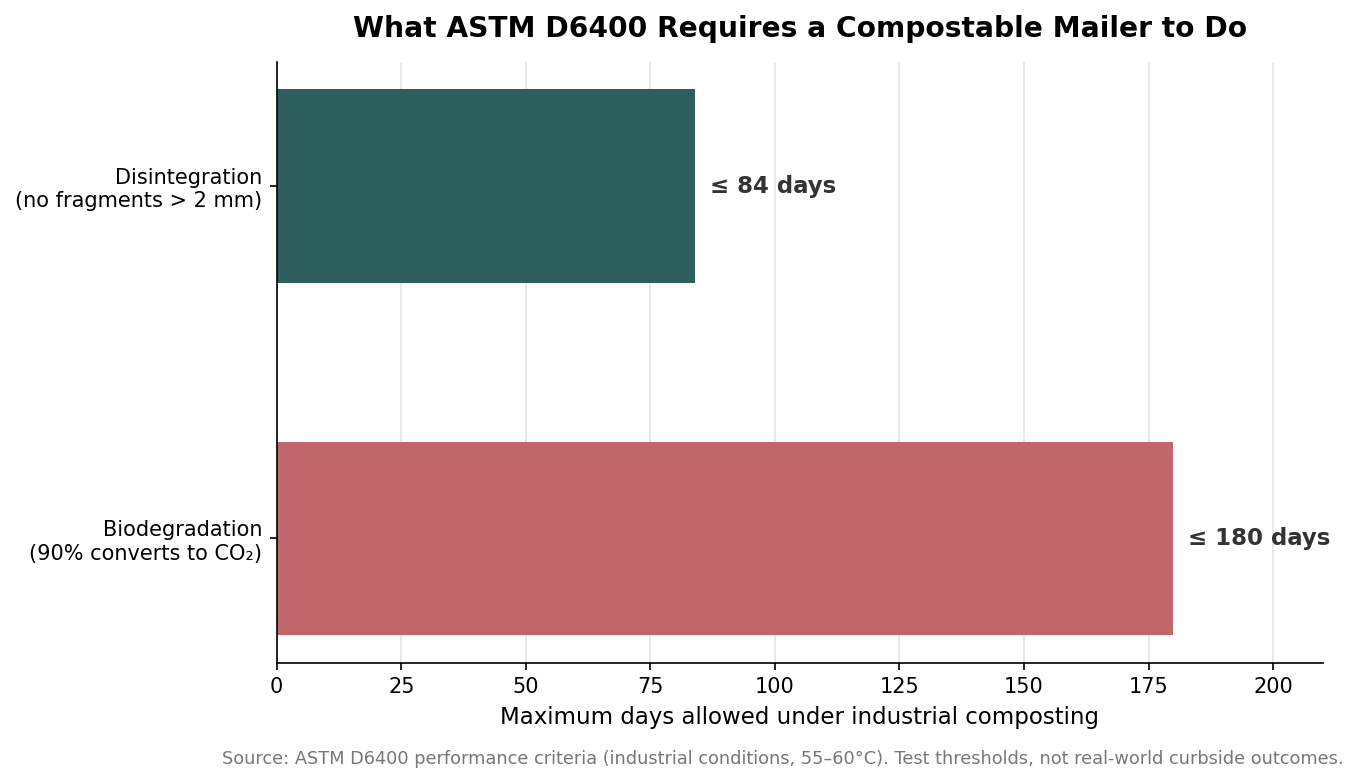
Compostable is a higher bar than recyclable, and it is far more specific than most listings admit. In the United States the reference standard is ASTM D6400. To meet it, a material has to biodegrade by converting at least ninety percent of its mass to carbon dioxide within one hundred eighty days, and it has to disintegrate so completely within eighty-four days that no fragments larger than two millimeters remain. The resulting compost also has to pass ecotoxicity and heavy-metal limits so it does not poison the soil it becomes part of.
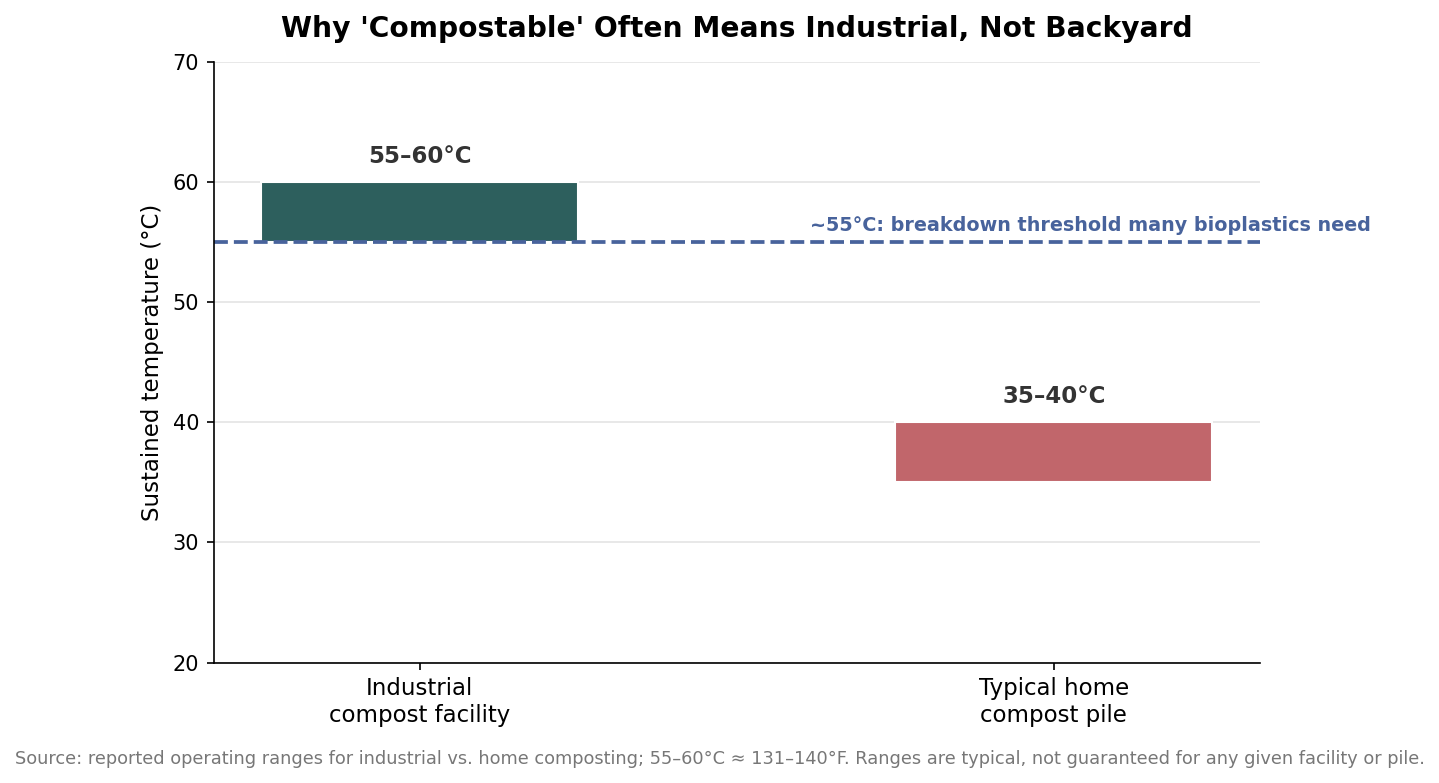
The catch is in the conditions. Those numbers only hold under industrial composting, which sustains temperatures of roughly fifty-five to sixty degrees Celsius, about one hundred thirty-one to one hundred forty degrees Fahrenheit. A typical backyard compost pile runs much cooler, closer to thirty-five to forty degrees, and many compostable materials simply stay intact at that temperature. That is why a mailer can be honestly labeled compostable and still never break down in a customer’s garden.
Certification is what separates a real claim from a hopeful one. The Biodegradable Products Institute, or BPI, does not write the standard; it verifies that a product meets ASTM D6400 through approved laboratory testing, full disclosure of every ingredient and colorant, and a public listing in its database. Certification typically takes ninety to one hundred eighty days and has to be renewed every three years. This is not just a marketing nicety. California and Washington now legally require BPI certification for anything sold as compostable in those states, so an untested “compostable” claim is a compliance exposure, not a selling point.
Why Biodegradable Is the Word to Avoid
Biodegradable is the most common term and the weakest. Almost anything biodegrades eventually; the question is whether it happens within a timeframe that means anything. The Federal Trade Commission treats an unqualified degradable claim as acceptable only if the item completely breaks down and returns to nature within about one year after customary disposal. Since most mailers end up in landfills, where nothing degrades on that schedule, an unqualified “biodegradable” claim on a mailer headed for the trash is exactly the kind of statement the FTC considers deceptive. Unless you can back it with data and a specific disposal context, biodegradable is a word to leave off the print file entirely.
How the Green Guides Police the Language
The FTC’s Green Guides set the rules for all three claims, and the throughline is qualification. A “recyclable” claim can be unqualified only if recycling facilities are available to at least sixty percent of the consumers or communities where the product is sold; below that, the claim has to be qualified with language like “recyclable only where facilities exist.” A “compostable” claim has to be qualified if home composting is not safe or timely, or if industrial facilities are not available to a substantial majority of buyers. The pattern is consistent: the less universally a claim is true, the more prominent your disclaimer has to be. For a mailer that ships nationwide, that usually means a short qualifying line printed near the claim itself.
Specifying a Mailer You Can Legally Stand Behind
Translate all of this into a spec sheet and the decisions get simpler. If you want the strongest defensible claim with the least friction for customers, an all-paper kraft mailer with paper cushioning and recycled fiber content is the safe path: it is genuinely curbside recyclable, it needs no special disposal instructions, and it sidesteps the compostable certification burden. If your brand story depends on compostability, budget for BPI-certified material and print the industrial-composting qualifier rather than implying it works in a backyard bin. As an indicative planning figure, custom printed kraft mailers commonly run somewhere in the range of thirty cents to well over a dollar per unit depending on size, quantity, and print coverage, with minimum orders often starting around five hundred to a thousand pieces and custom production lead times frequently landing near two to four weeks; treat those as starting points to confirm with your supplier, not fixed quotes.
The mailer is often the first physical thing a customer touches from your brand, and the sustainability claim on it is a promise. Match the claim to the construction, qualify it the way the Green Guides expect, and the packaging will hold up to scrutiny long after the box is opened.