Brands switch to kraft mailers to save money, and they usually do save, but the reason is often misunderstood. A mailer being cheaper than a box is not one saving, it is two separate mechanisms working at once, and only one of them is about the price you pay the printer. The other is about how carriers weigh your parcel, and that math changed for United States Postal Service shippers in the summer of 2026. Understanding both is the difference between guessing that mailers are cheaper and knowing by how much on your specific orders.
Two different ways a mailer saves money
The first saving is the obvious one: material and tare weight. A flat kraft mailer weighs a fraction of a corrugated box, and packaging suppliers commonly quote mailers well under a dollar each at volume against boxes that rarely drop below a dollar even in large runs. Because the mailer itself is lighter, less of your billable weight is packaging and more of it is product. On a light item, shaving several ounces of box off every parcel adds up quickly across a month of orders.
The second saving is dimensional weight, and it is the one that surprises people. Carriers do not always charge by what a parcel actually weighs. When a package takes up a lot of space relative to its weight, they charge for the space instead. A box full of a folded hoodie is mostly air, and that air can be billed as if it were pounds. A mailer that lies nearly flat holds far less air, so it tends to bill much closer to its true weight. This is why two identical products, one boxed and one in a mailer, can cost meaningfully different amounts to ship the same distance.
How dimensional weight actually works
Dimensional weight is calculated from the parcel’s outer dimensions: multiply length by width by height in inches, then divide by a number the carrier sets called the DIM divisor. The result is a weight in pounds, and the carrier bills you on whichever is greater, the actual weight or this dimensional weight. A smaller divisor produces a larger dimensional weight, so the divisor is not a footnote, it is the lever that decides how much your empty space costs.
Where carriers differ sharply is when the rule applies. UPS and FedEx apply dimensional weight to essentially every parcel, which is why a small but boxy shipment can bill above its real weight even when it is light. USPS is more forgiving at the low end: it applies dimensional weight only to packages larger than one cubic foot, which is 1,728 cubic inches. Most flat mailers never come close to that volume, so on USPS they bill on actual weight and sidestep dimensional charges entirely. The chart below shows the effect on a single light order priced under a divisor of 139, the figure that now applies to all parcels at UPS and FedEx.
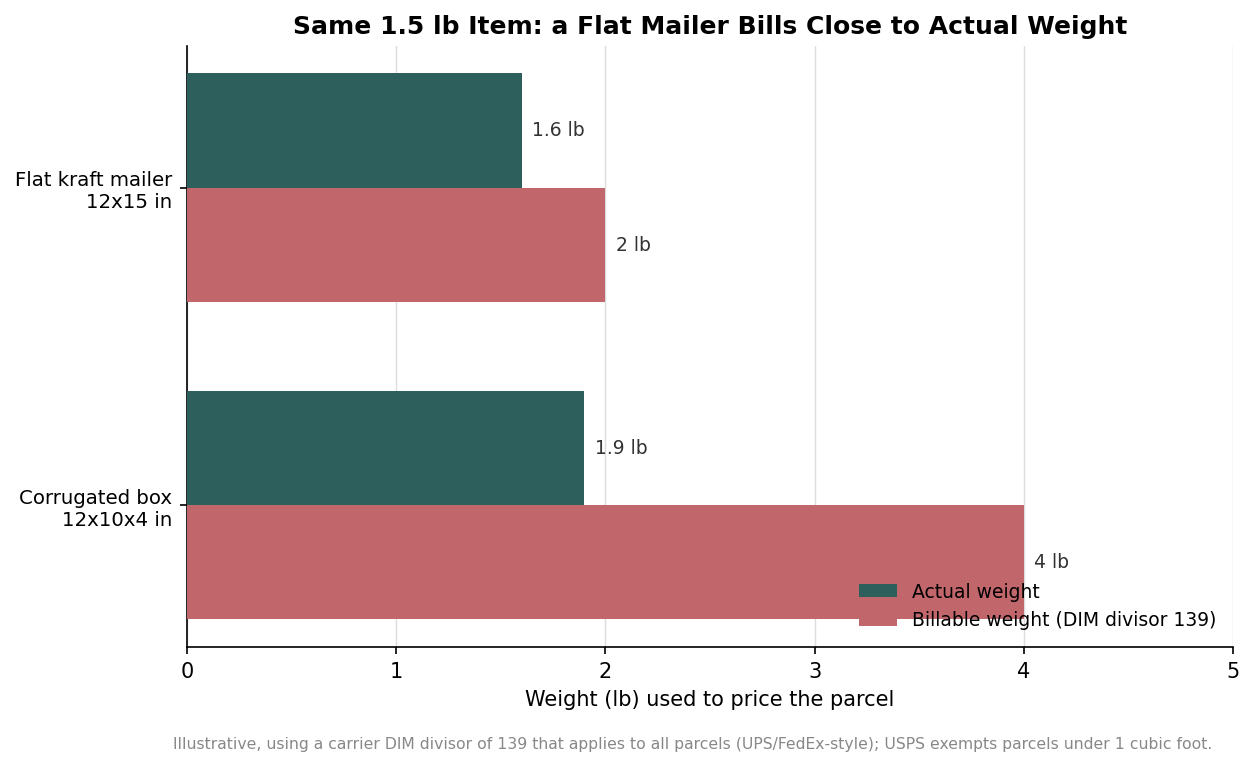
The practical takeaway is that a mailer’s dimensional-weight advantage is largest on the carriers and lanes where the rule bites hardest. If you ship small light goods by USPS under a cubic foot, both a mailer and a modest box may bill on actual weight, and the mailer still wins on tare weight and material cost. If you ship by UPS or FedEx, or by USPS in larger parcels, the mailer’s flat profile can save a whole billable pound or more per order.
What changed at USPS in July 2026
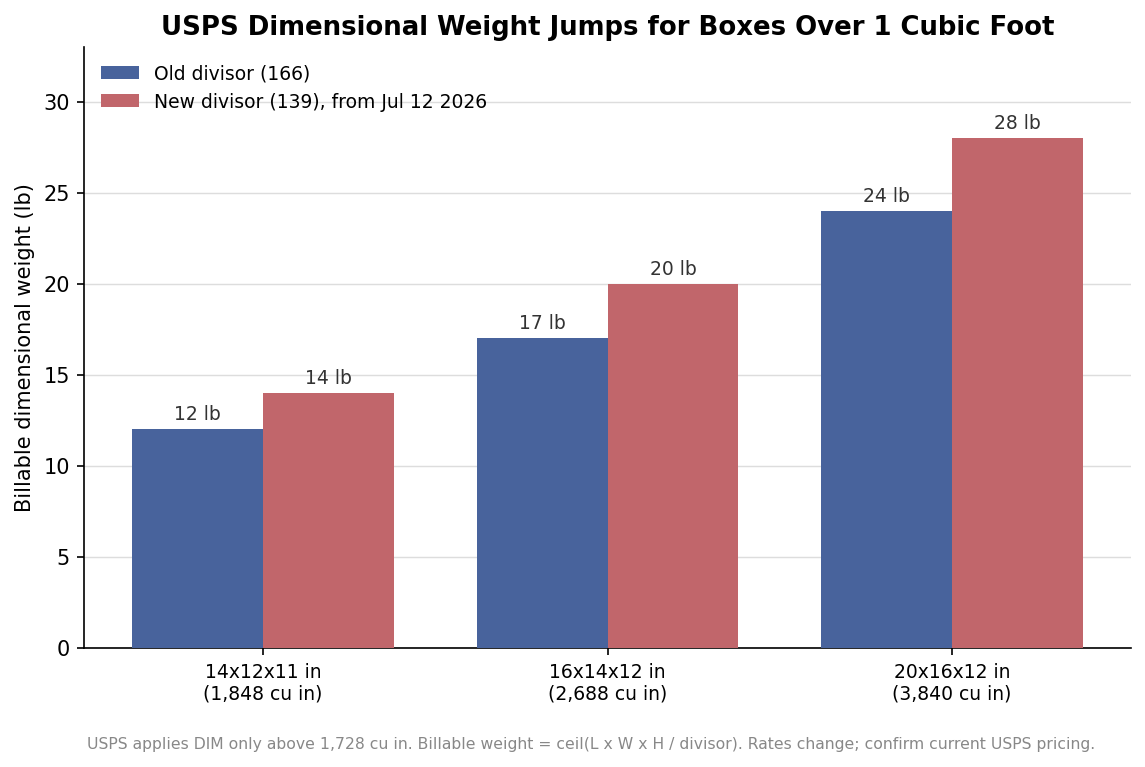
On July 12, 2026, USPS lowered its dimensional weight divisor from 166 to 139 for Priority Mail Express, Priority Mail, Ground Advantage, and Parcel Select. Because a smaller divisor yields a larger dimensional weight, the same box now bills heavier than it did before. USPS also tightened the rounding rule so that any fractional dimension rounds up to the next whole inch before the math runs, which nudges billable weight up again on parcels that were previously measured to a fraction. The one-cubic-foot threshold stayed in place, so parcels under 1,728 cubic inches are still billed on actual weight.
The people this hits are those shipping larger boxes. A 14 by 12 by 11 inch box that billed at 12 pounds under the old divisor now bills at 14, and the gap widens as the box grows, as the comparison below lays out. For a brand that was shipping bulky boxes half full, the change is a direct rate increase with no change to what is inside. It is also a strong argument for right-sizing packaging, because the cheapest way to avoid paying for a bigger dimensional weight is to stop shipping the empty space that creates it. These figures follow the published formula, but carrier pricing changes over time, so confirm the current divisor and rates with USPS before you model a full year of postage on them.
When a mailer is the right call, and when it is not
None of this makes a mailer universally correct. A mailer earns its saving on soft, durable, non-fragile goods that tolerate being flat and flexed: apparel, textiles, accessories, printed matter, and sealed items that will not crush. The moment a product is rigid, breakable, or sharp-cornered, the box you were trying to avoid may be doing real protective work, and the cost of a single damaged order and its replacement, return, and lost goodwill can erase the postage you saved across many parcels. The right frame is total cost per delivered order, not postage in isolation.
If a mailer does fit the product, the way to protect the saving is to keep the parcel genuinely flat. Choose a mailer sized so the item lies in a single layer without forcing a bulge, since a stuffed mailer starts to behave like a box for measurement. Pad only where the product needs it, and reserve poly-lined or padded kraft styles for items that need moisture resistance or cushioning rather than defaulting to them everywhere. Specified this way, a kraft mailer captures both savings at once, the lighter material and the lower dimensional weight, and it keeps doing so even after the 2026 rate math made empty space more expensive than it used to be.