Ask two suppliers for a strong kraft mailer and you will often get two numbers back, a basis weight in pounds or a grammage in gsm, as if the higher number settles it. It does not. Paper weight tells you how much a square meter of the stock weighs, which correlates loosely with strength, but a mailer fails at its seams, its die-cut corners, and along the grain, and none of those are captured by a single weight figure. Knowing how to read the weight, and knowing what it leaves out, is what keeps you from over-paying for heavy paper that still tears, or under-speccing a light one that arrives split.
What the weight number actually means
Kraft is sold two ways. In North America it is often quoted as a basis weight in pounds, the weight of 500 sheets at a standard size, and for kraft that standard is usually 24 by 36 inches. Elsewhere, and increasingly everywhere, it is quoted in gsm, grams per square meter, which is the cleaner measure because it does not depend on a sheet size you have to memorize. For the 24-by-36 kraft standard you convert pounds to gsm by multiplying by about 1.63, so a 50-pound kraft is roughly 80 gsm and an 80-pound kraft lands near 130.
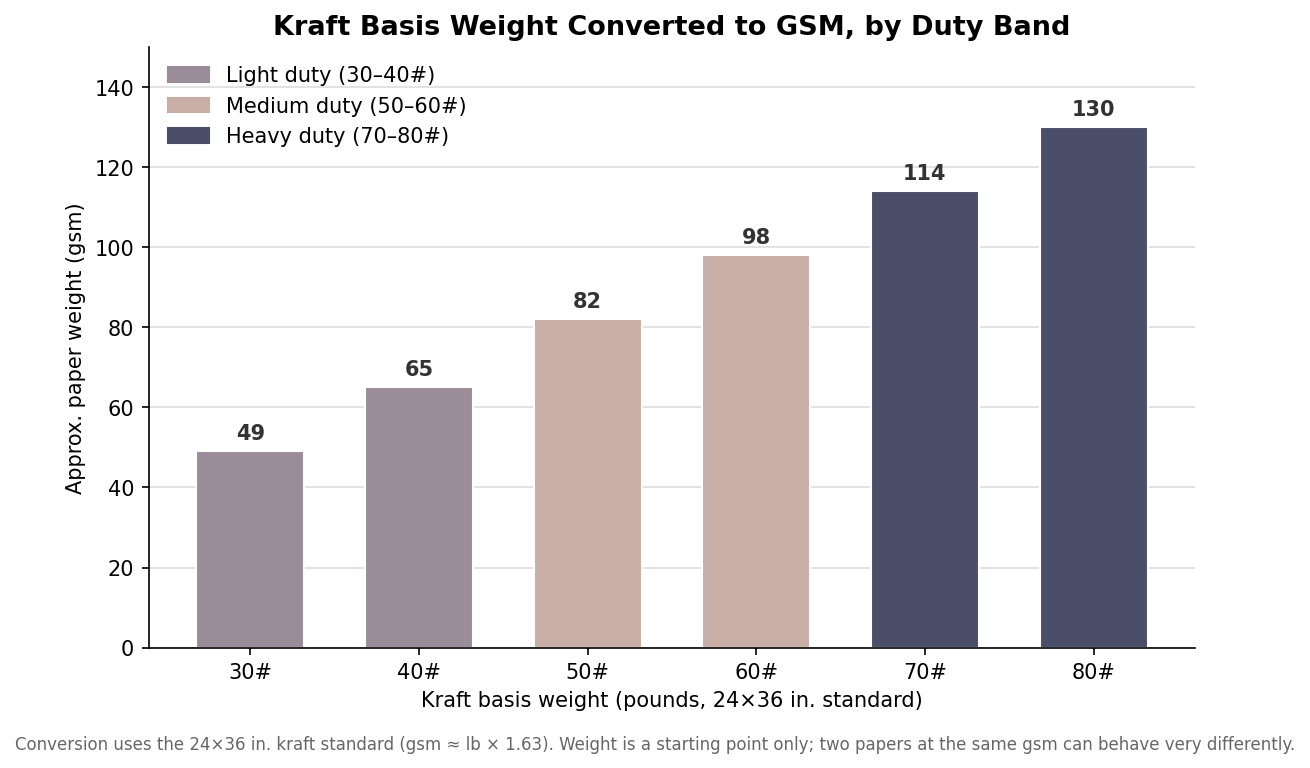
Those bands map loosely onto duty. Light kraft in the 30 to 40 pound (about 49 to 65 gsm) range suits document mailers and soft goods; medium kraft around 50 to 60 pound (80 to 98 gsm) covers most everyday direct-to-consumer parcels; and heavier 70 to 80 pound (114 to 130 gsm) stock is what you reach for when contents are dense or have edges that want to poke through. That is a fine starting point. It is a poor finishing point.
Where weight quietly misleads
Two papers at the same gsm from different mills can behave completely differently on the same folding and gluing line, because weight says nothing about fiber length, refining, or how the sheet was made. The properties that decide whether a mailer survives a sorting machine and a mailbox are tear resistance, burst strength, and fold endurance, and they do not track weight one-for-one. A well-made 90 gsm recycled kraft can out-tear a cheap 110 gsm sheet, and a stiffer sheet that resists folding cleanly may actually crack at the crease rather than hinge, so more weight is not always more durability.
Direction matters too. Paper is stronger along the grain, the machine direction, than across it, the cross direction, so a mailer can be sturdy end-to-end yet split easily side-to-side if the grain runs the wrong way relative to the opening. And the place mailers actually fail is rarely the flat panel, it is the die-cut corners and the glued seams, where stress concentrates. A flat-sheet tear rating looks reassuring and still tells you nothing about how the corner of your particular die line will hold. This is why experienced buyers ask for tear values in both directions and, ideally, a trial run on the finished mailer rather than a number off a flat sheet.
Recycled versus virgin is not a weight question
It is tempting to assume virgin kraft is automatically stronger than recycled, and to bump up the weight to compensate for recycled content. The honest answer is that it depends on the furnish and the mill. Recycled fibers are shorter on average, which can lower tear strength, but a well-designed recycled grade with good processing can match a virgin grade for most mailer duties. The wrong move is to treat the recycling label as a strength penalty and reflexively over-spec the paper. The right move is to ask the supplier for the actual strength data on the actual grade, recycled or not, and let the numbers decide.
Choose the weight, then pressure-test it
Start from the contents, not the paper. Match a weight band to what the mailer carries, then verify it against the failure modes that matter.
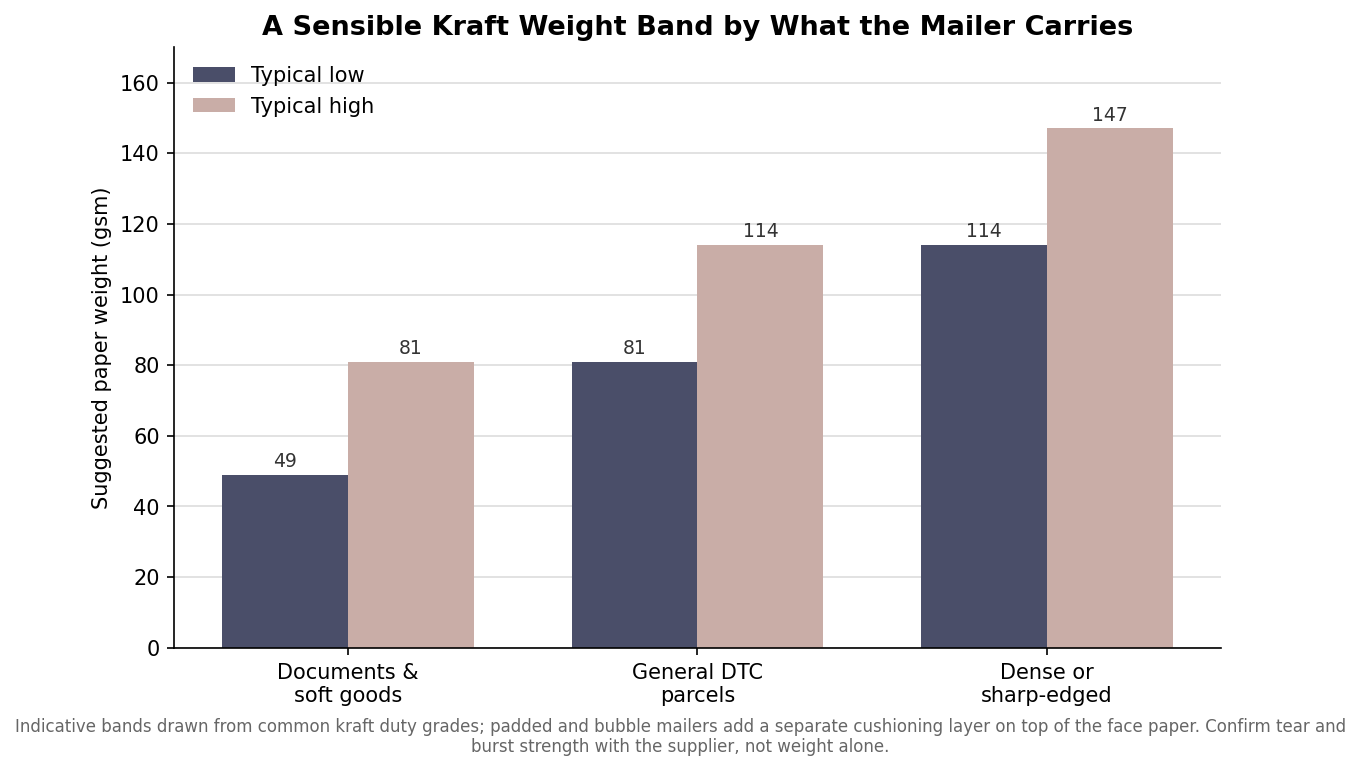
For flat documents and light soft goods, the lower band is usually plenty. For general parcels, the bulk of direct-to-consumer shipping, a middle-weight kraft balances protection against postage, since paper weight is also parcel weight and heavier stock quietly raises your shipping cost on every unit. For dense, heavy, or sharp-edged items, move up a band, and remember that padded and bubble mailers add a separate cushioning layer on top of the face paper, so the outer kraft does not have to carry the whole job alone. Whatever band you land in, get the supplier’s tear and burst figures in machine and cross direction, run a real drop-and-mail test on a sample before committing to a print run, and check the corners afterward. If the paper survives the corners and the mailbox, the weight was right; if it does not, no amount of extra gsm on the spec sheet would have told you in advance.
Use the number, but do not trust it alone
Weight is the first thing to ask about and the last thing to rely on by itself. Use it to get into the right neighborhood, then let tear, burst, fold, and a finished-mailer trial confirm the choice. Ask for grammage rather than a pound figure when you can, because it travels across suppliers and countries without a conversion in your head, and pair every weight you are quoted with the strength data behind it. That is the difference between a mailer that looks strong on paper and one that actually arrives intact.