The choice between a kraft mailer and a poly mailer is really a choice between paper and plastic film, and those two materials behave differently in almost every way that matters once a package leaves your hands. Both ship soft goods and small items well. But they diverge on water resistance, weight, the way they protect fragile contents, how a customer recycles them, and how your logo looks on the outside. This is a spec-by-spec comparison to help you match the format to the product rather than to a trend.
Paper structure versus plastic film
A kraft mailer is built around paper. The most common padded version pairs a kraft paper face, often around a 52 lb weight, with an inner bubble layer of either 1/8 inch or 3/16 inch to cushion the contents. Flat kraft mailers and rigid kraft mailers skip the cushioning and rely on the stiffness of the paperboard itself. A poly mailer, by contrast, is a single sheet of co-extruded polyethylene film, usually somewhere between 2 and 6 mil thick, sealed on the edges with a permanent adhesive strip. The practical upshot is simple: paper gives you rigidity and a premium surface, while film gives you a lightweight, flexible, inherently water-resistant skin.
Protection and water resistance
Water is where the two formats separate most clearly. Polyethylene does not absorb moisture, so a poly mailer shrugs off rain, damp warehouses, and wet porches without any added treatment. Raw kraft paper wicks water, and a plain paper mailer left in a puddle will soften and can fail. Manufacturers close that gap with a poly or wax coating, or with the plastic bubble lining inside a kraft bubble mailer, but you should assume an uncoated paper mailer is not weatherproof and specify a lining or coating if your route exposes parcels to the elements.
For impact protection, the deciding factor is cushioning rather than the outer material. A bubble layer, whether wrapped in kraft or in poly, is what absorbs a drop; a flat poly mailer with no padding protects soft goods but does little for anything that can crack. Film thickness is the poly equivalent of paper weight, and heavier gauges resist punctures and sharp corners better. The chart below shows the gauges you will typically be offered and the loads they are generally used for, though these are common conventions rather than strict engineering ratings.
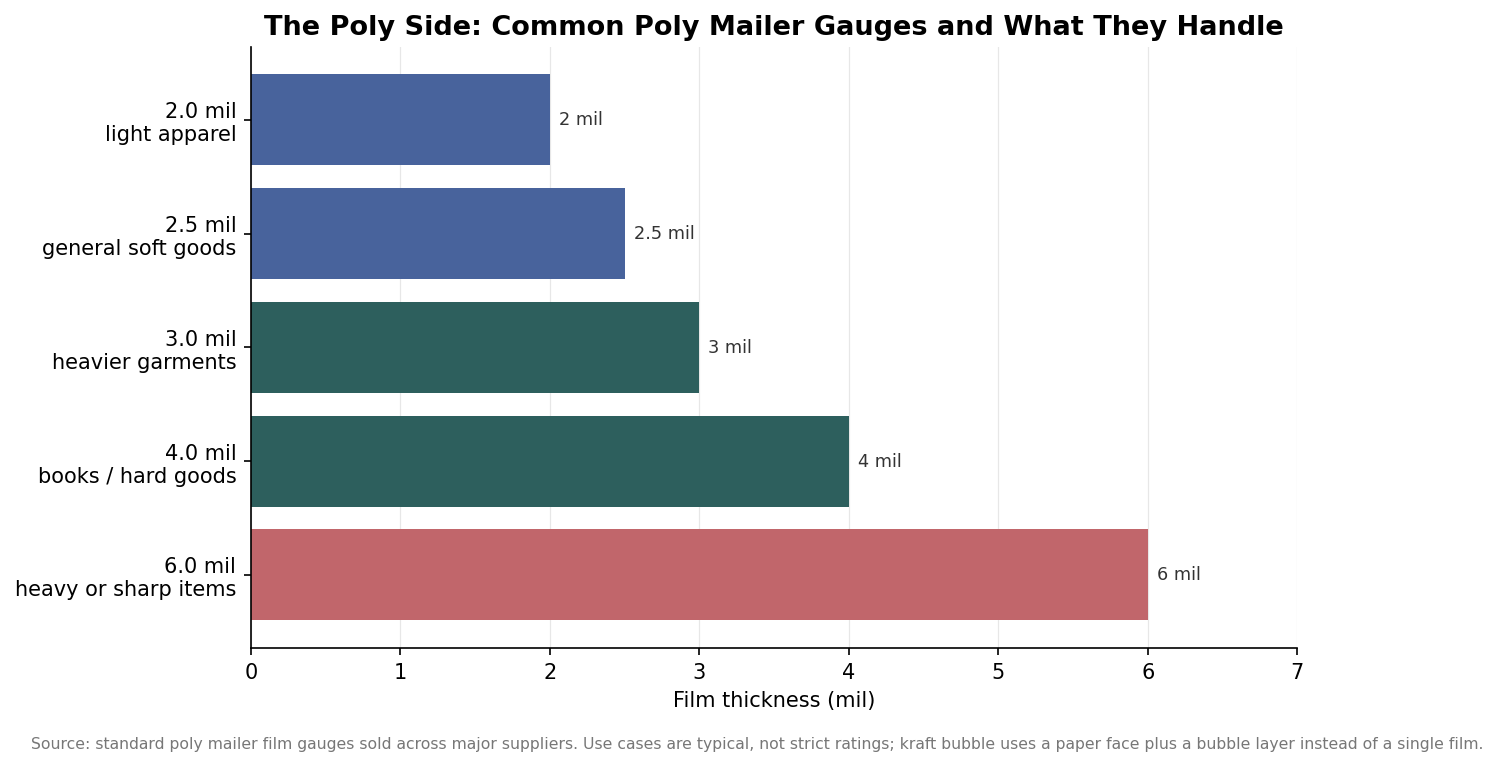
If your product is apparel or another soft good, either format works and the decision comes down to branding and cost. If it has hard edges, corners that can poke through, or anything that can shatter, you want a bubble layer or a rigid mailer, and the outer material becomes a secondary question.
Sizes, weight, and what it does to postage
Kraft bubble mailers follow a well-established set of trade sizes, numbered from #000 at roughly 4 by 8 inches up to #7 at about 14.25 by 20 inches. Those numbers are inside or usable dimensions; the outer envelope runs about half an inch to an inch larger, which matters when your item is a tight fit. Poly mailers are sold in similar footprints but are generally cut to order more freely, so you are less locked into the numbered ladder.
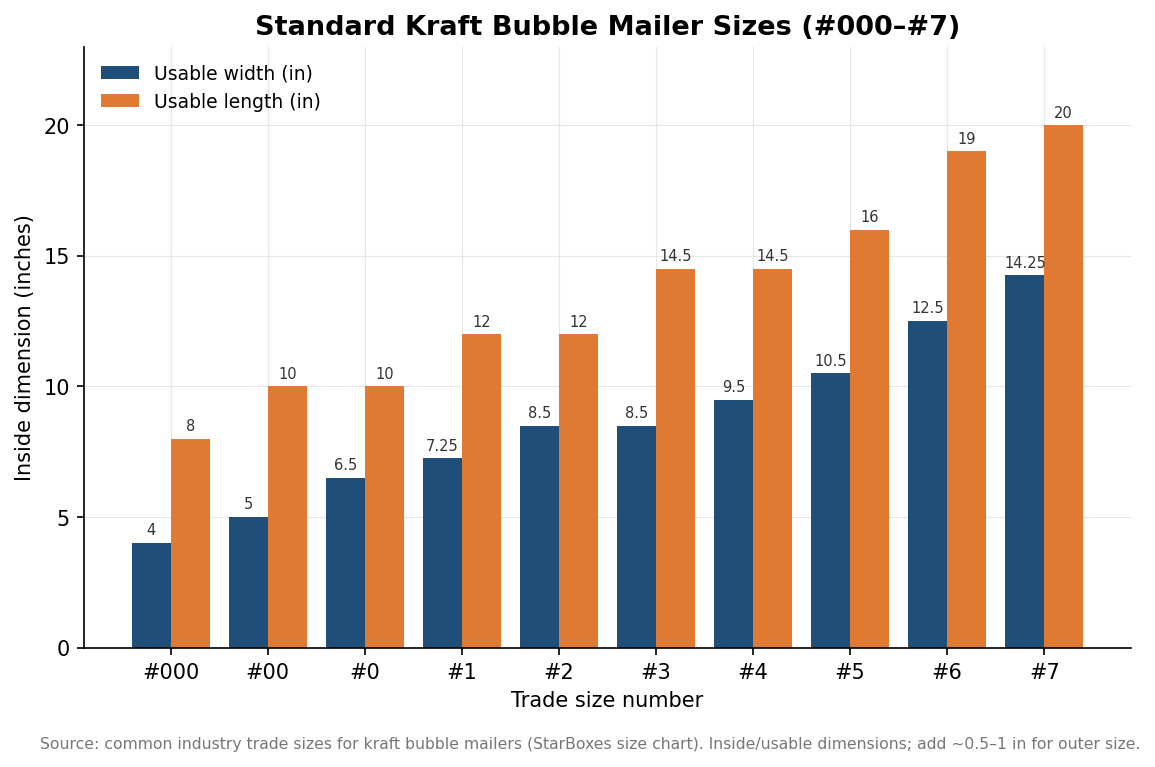
Weight is the quiet cost driver. A flat poly mailer adds almost nothing to a parcel, a lightweight film skin and an adhesive strip. A kraft bubble mailer adds noticeably more, because paper is denser than film and the padded versions carry a bubble layer as well. For very light products shipped in the lowest postage bands, that extra tare weight can be the difference that nudges a package into the next price tier, so weigh a fully packed sample before you commit to thousands of units. The size chart above is a good planning tool: pick the smallest size that fits your product with a little slack, since oversizing wastes both material and dimensional space.
Recycling and the claim buyers get wrong
This is the area where well-meaning brands make honest mistakes on their packaging inserts. A flat, uncoated kraft paper mailer and an all-paper padded mailer are widely accepted in curbside paper recycling across most United States municipalities, which is a real advantage if your audience cares about easy disposal. A poly mailer is made of low-density polyethylene, the same store drop-off film as grocery bags, so it is recyclable in principle but only through retail collection points, and most shoppers never make that trip. The trap is the kraft bubble mailer with a plastic bubble lining: it is a mixed material, and unless the customer separates the paper from the film it usually does not belong in either stream. If curbside recyclability is a promise you want to make, choose a flat or all-paper padded kraft mailer, or verify that the bubble lining is paper-based, rather than assuming that a paper exterior makes the whole thing curbside-ready.
Printing, cost, and how to decide
Kraft has a look that many brands want, an unbleached, natural surface that reads as premium and low-waste. The tradeoff is that brown kraft absorbs ink and mutes color, so light or vivid artwork needs a white underbase to stay crisp, and many brands lean into one or two-color designs that suit the material. White kraft gives you a brighter canvas at a small premium. Poly mailers print well too, in full color on the film, and come in a range of stock colors, but the finish always reads as plastic rather than paper. On price, poly has traditionally been the cheaper per-unit option because film is inexpensive and light, though the gap has narrowed as paper mailer supply has grown.
Put it together and the decision is less about which format is better and more about which tradeoffs you are buying. Reach for kraft when brand perception and an easy recycling story matter, when your contents need the rigidity or cushioning that paper and bubble provide, and when your route keeps parcels reasonably dry or you add a liner. Reach for poly when you need genuine waterproofing, the lowest possible weight and unit cost, or a flexible fit for soft goods, and when a plastic finish suits the product. Order a small sample of each in your real size, pack your actual product, and put both on a scale before you scale up; the winner is usually obvious the moment you hold a loaded sample in each hand.